
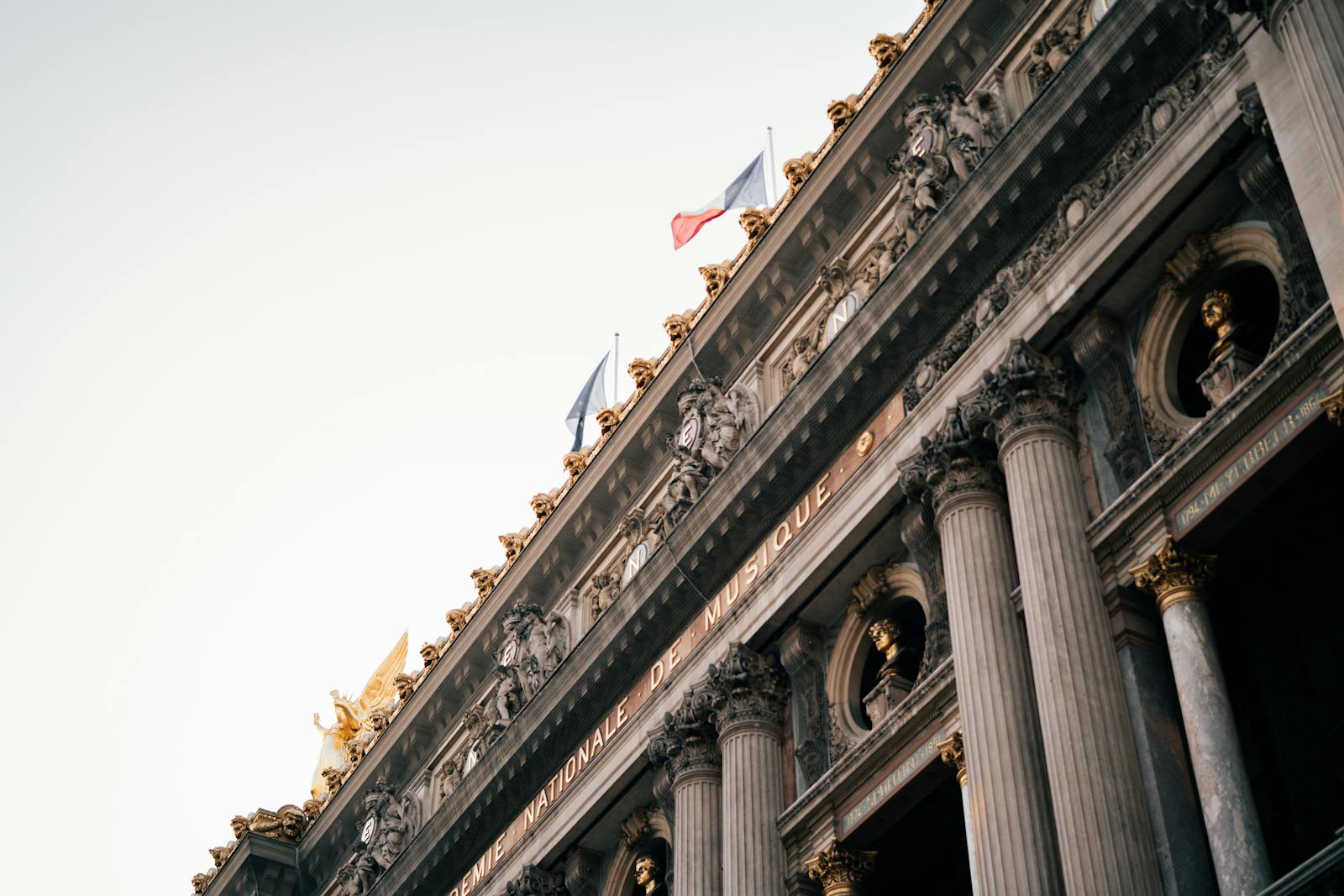
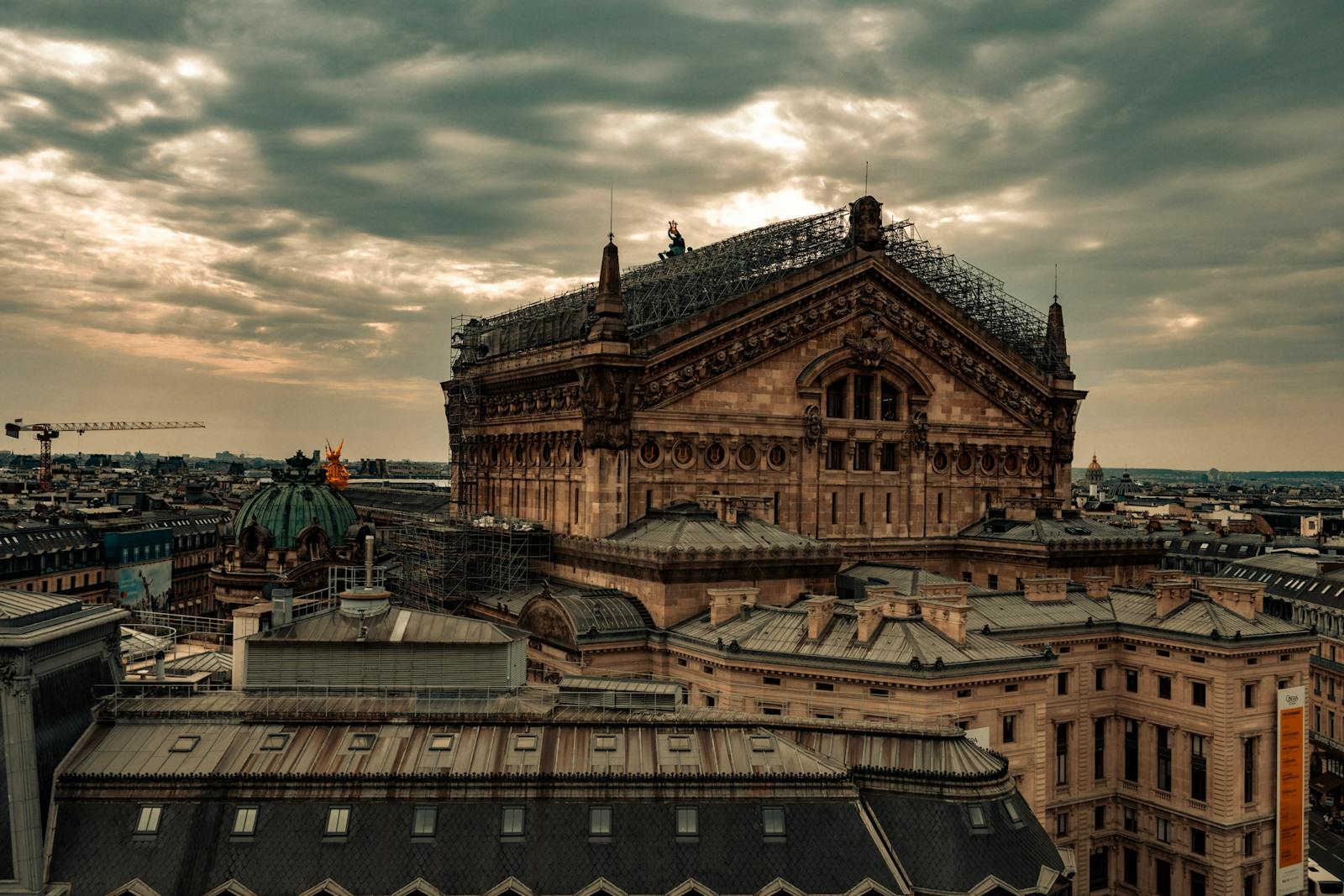
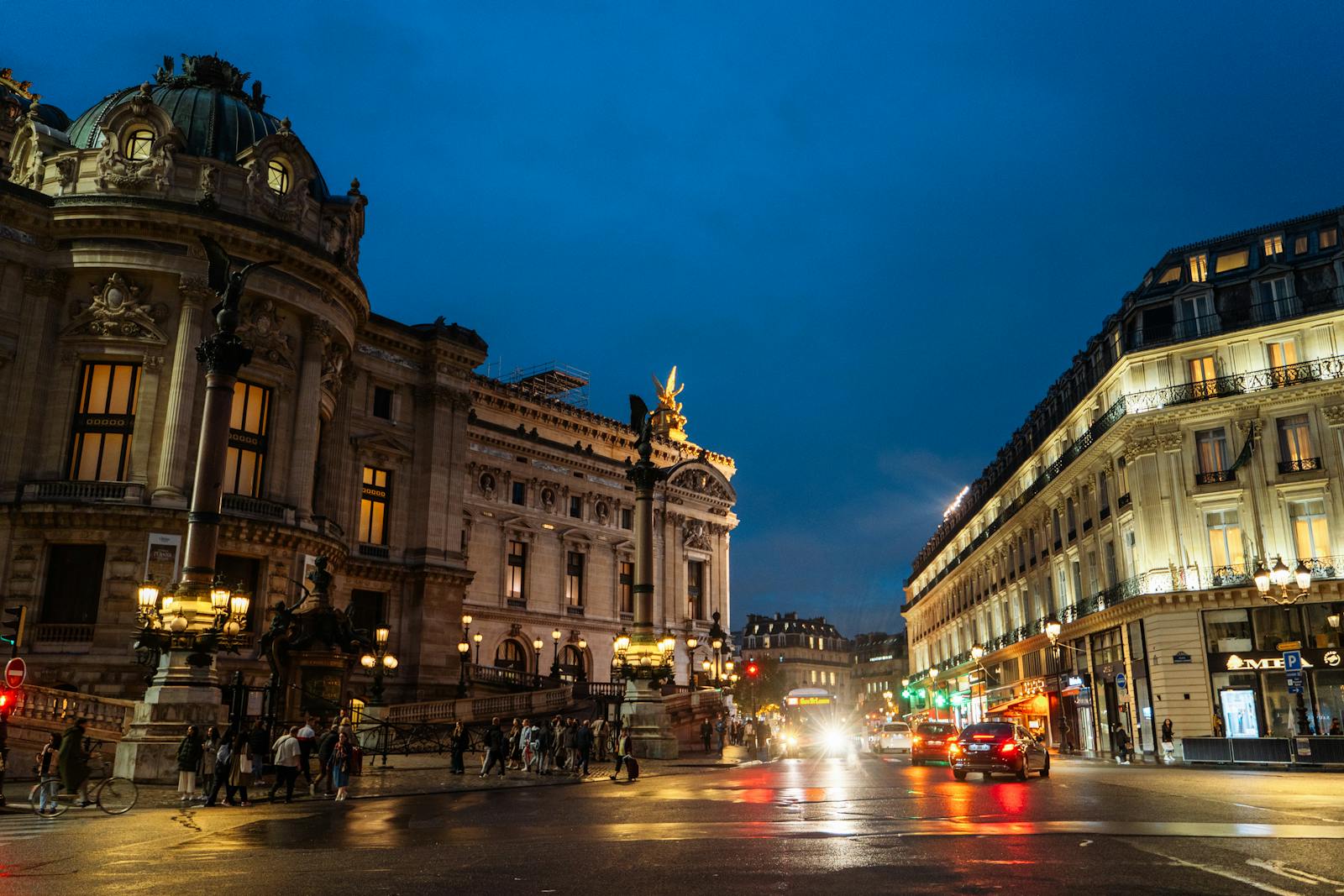
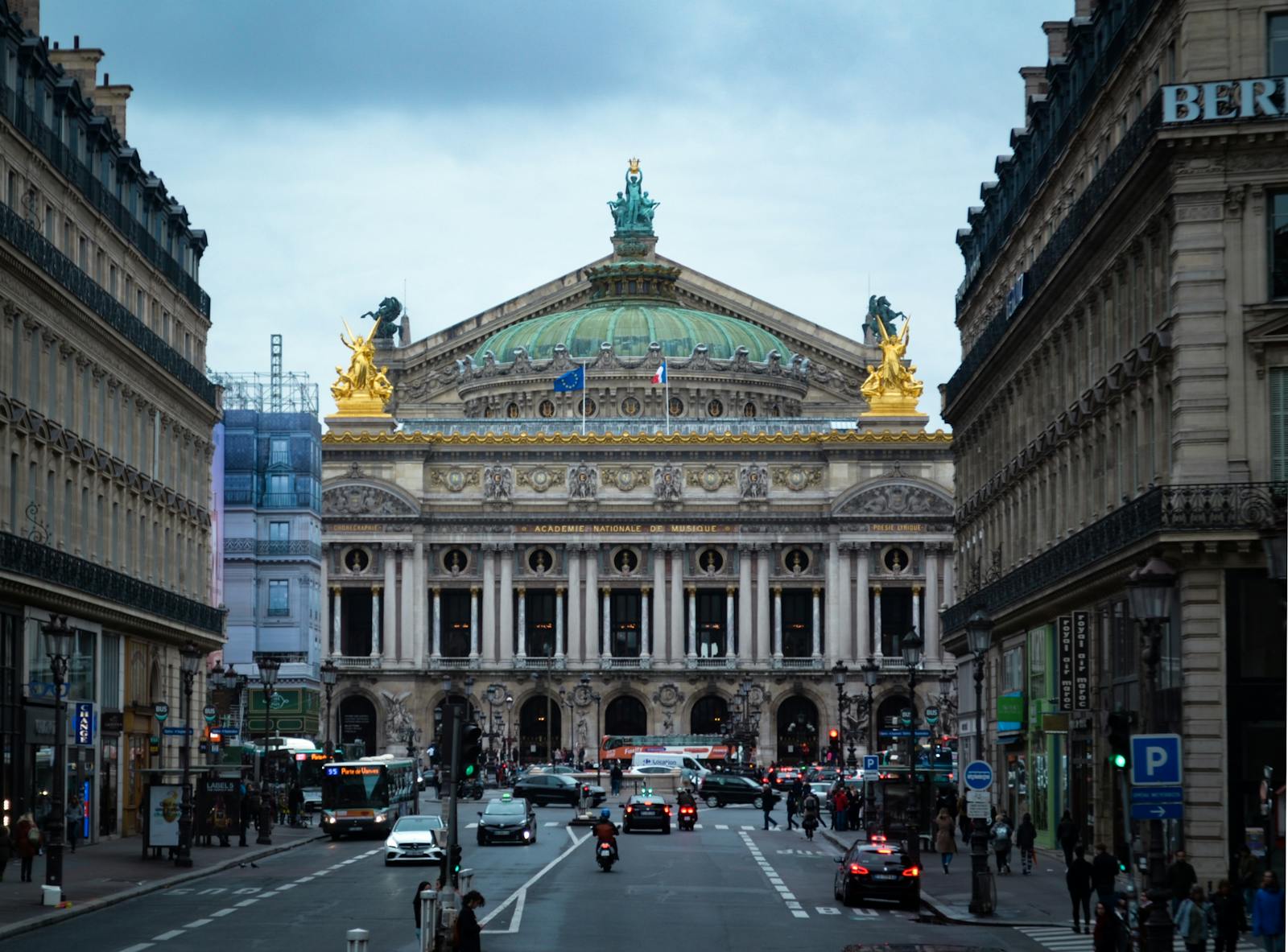
The Palais Garnier is the 1875 opera house Charles Garnier built for Napoleon III that became the most-copied building in late-19th-century Europe — the model for opera houses from Vienna to Rio de Janeiro — and the physical setting that inspired Gaston Leroux’s The Phantom of the Opera. Today it still hosts ballet and opera performances under its Marc Chagall ceiling, but it also functions as a museum you can tour during the day for under $20. For first-time Paris visitors, it’s one of the best value interiors in the city: a full working palace of the Second Empire for less than the price of a rooftop cocktail down the street.
The four ticket options below cover the full range of how people actually visit. The flagship entry ticket from GetYourGuide is the cheapest and most popular, a combined Garnier-plus-Seine-cruise bundle adds a river ride for a small premium, a treasure-hunt-style mystery game turns the visit into an interactive experience for families and couples, and a private guided tour delivers the full Garnier history with a dedicated guide for travelers who want the context rather than just the visuals.
- Quick Picks
- The Four Best Ways to Visit Palais Garnier
- 1. Paris: Opera Garnier Entry Ticket
- 2. Paris: Opera Garnier and Seine River Cruise Tickets
- 3. Paris: Palais Garnier Mystery Game With Entry Ticket
- 4. Private Opera Garnier Theater 2-Hour Tour in Paris
- A Short History of the Palais Garnier
- The Phantom and the Lake
- The Chagall Ceiling
- What You’ll Actually See
- Practical Tips Before You Book
- Alternatives If These Aren’t Right
- More Paris and France Guides
- Which Tour Should You Actually Book?
- Final Word
Quick Picks
Best overall for most visitors: Paris: Opera Garnier Entry Ticket (Tour #1 below). At $18 per person with 16,070 reviews at 4.6 stars, it’s the single most-booked Palais Garnier product on the market for a reason — reserved access entry, free movement through the building at your own pace, audio guide typically available via the app, and no guided-tour pacing to slow you down. Budget about 90 minutes inside to see everything worth seeing.
Best combo for a half-day plan: Paris: Opera Garnier and Seine River Cruise Tickets (Tour #2). For $42 you get Palais Garnier entry plus a one-hour Seine sightseeing cruise, bundled together with a single voucher. The math works out well if you were already planning to do both (which most first-timers are) because the combined price is roughly $6-$10 below buying them separately.
Best for couples and families who want an interactive experience: Paris: Palais Garnier Mystery Game With Entry Ticket (Tour #3). A self-guided treasure hunt through the opera house with entry ticket included at $32 per person. The game layer adds a reason to look at architectural details you’d otherwise walk past, and the format works well for groups with kids or anyone who finds audio guides boring.
The Four Best Ways to Visit Palais Garnier
1. Paris: Opera Garnier Entry Ticket
This is the flagship reserved-access ticket from GetYourGuide, and with 16,070 reviews at a 4.6 average it’s by a wide margin the most-booked Palais Garnier product on any platform. $18 per person, which is within a dollar or two of the official website price — you’re not paying a significant markup for the convenience of booking through a third party. Reserved access means you skip the general admission line (which can run 30-45 minutes on summer weekends) and enter through a dedicated turnstile with a timed slot. Once inside, you move through the building at your own pace — no guide, no group.
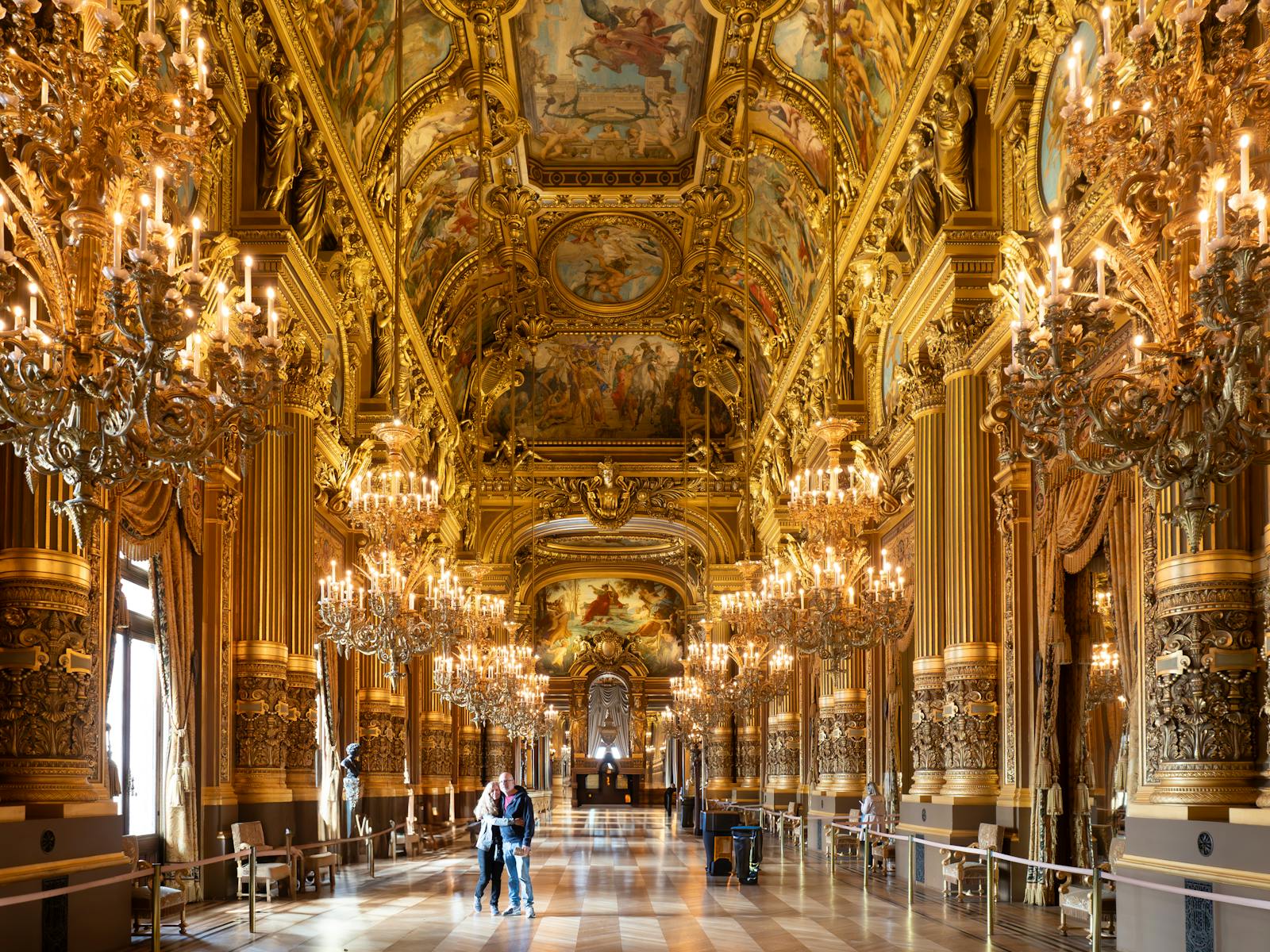
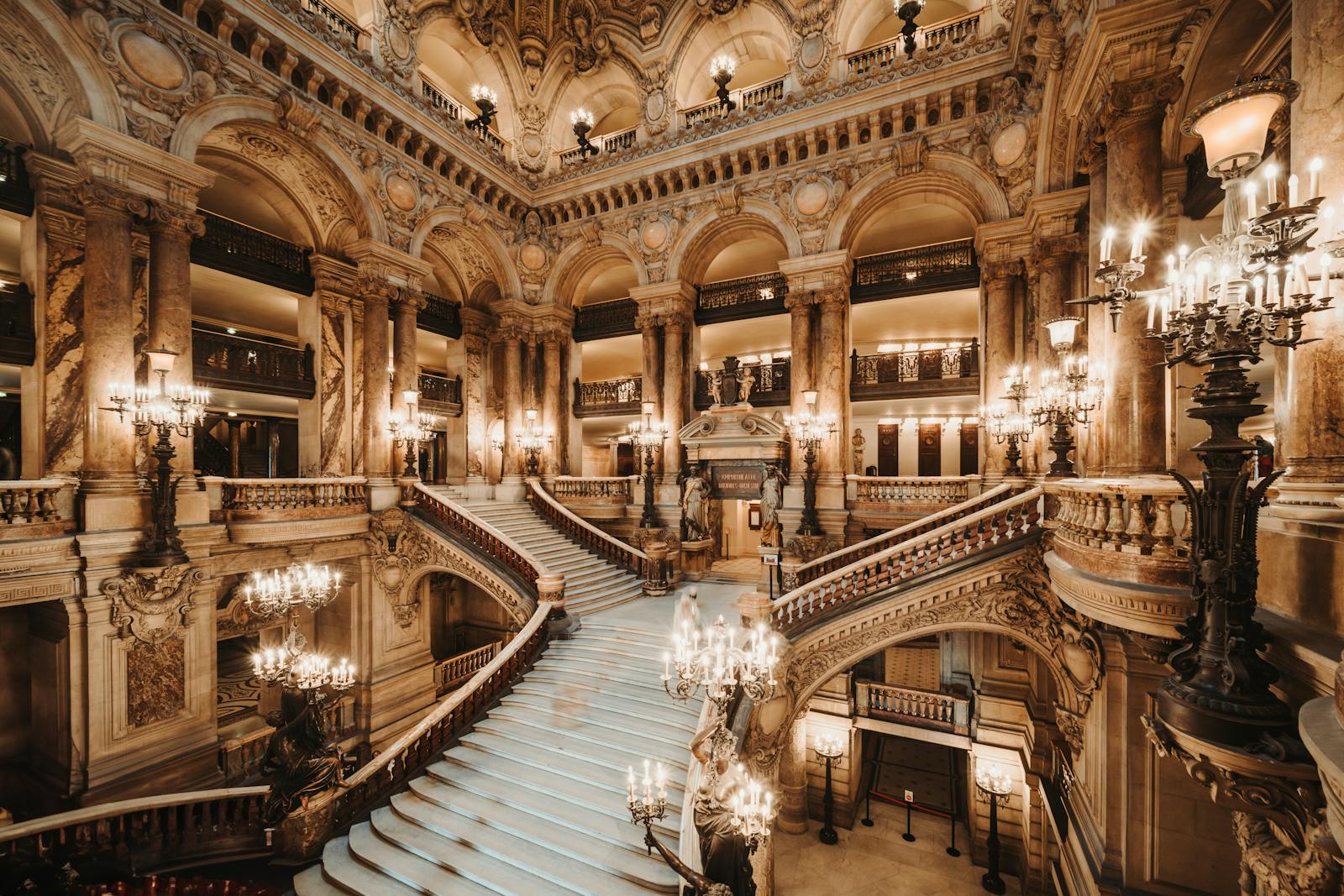
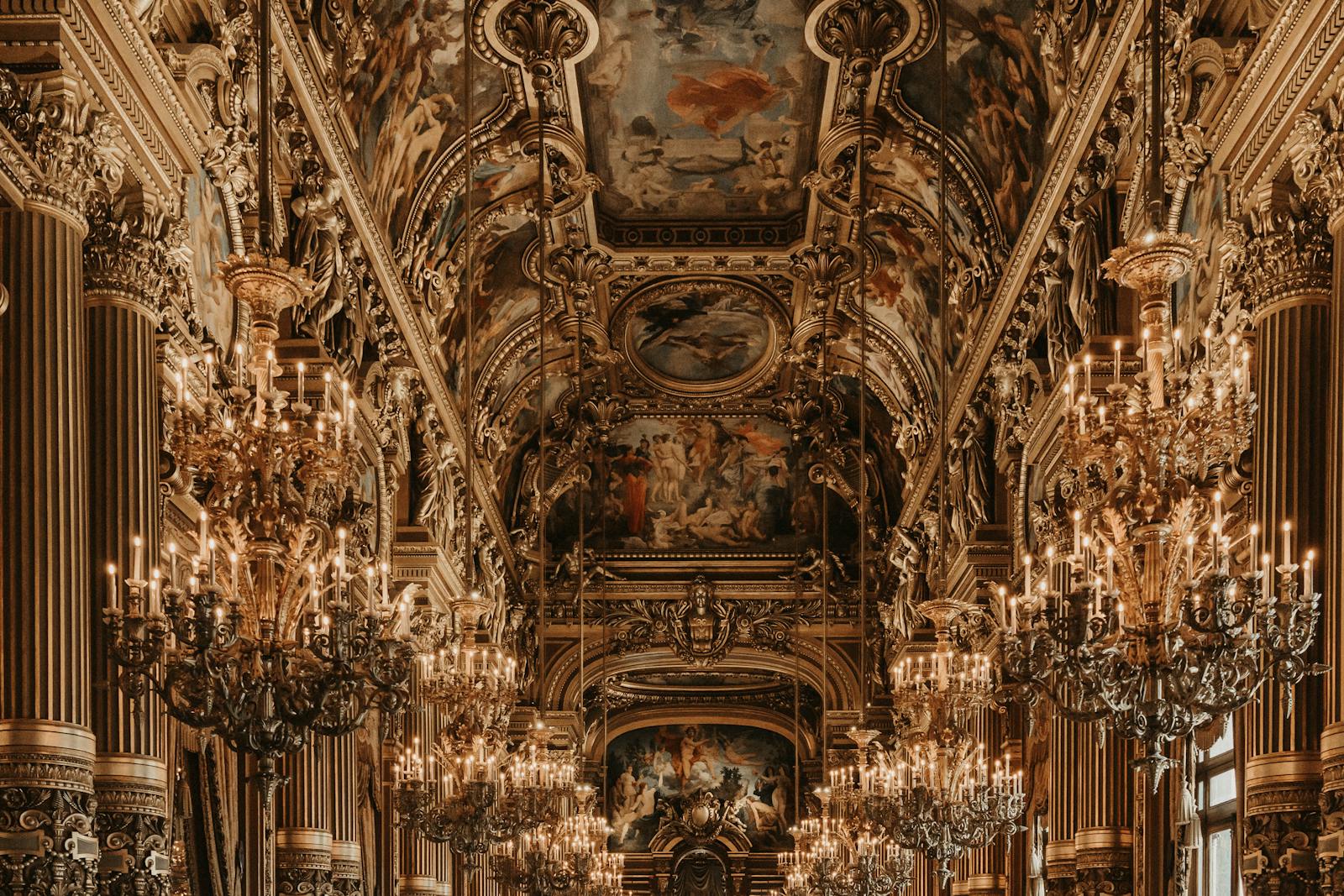
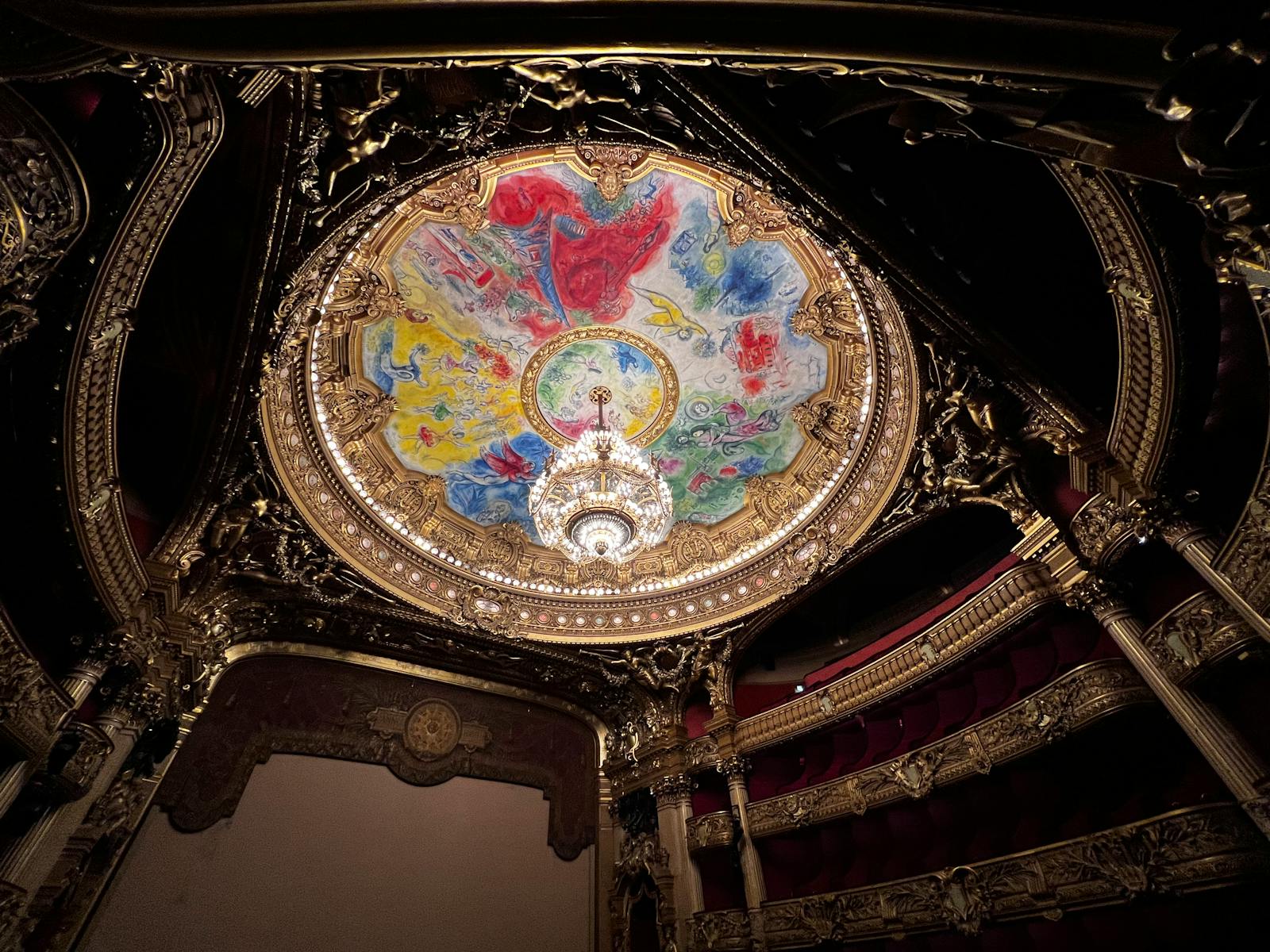
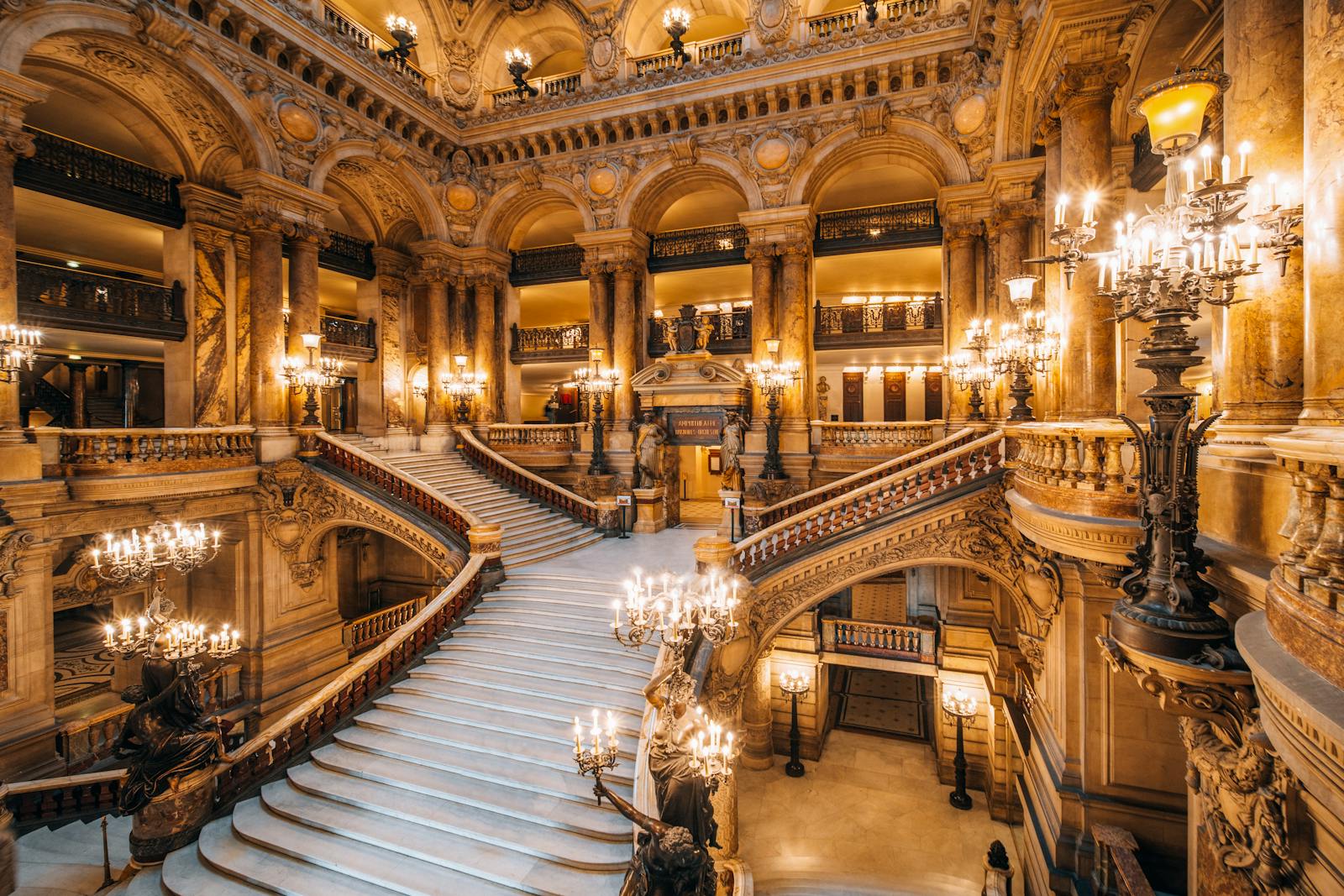
The self-guided tour covers everything that’s worth seeing: the Grand Staircase (the marble-and-bronze main entrance hall that’s on every postcard), the Grand Foyer (the enormous mirrored gallery modeled on the Hall of Mirrors at Versailles), the auditorium itself (where you can sit in the stalls and look up at the Chagall ceiling — added in 1964 and initially controversial because it was painted over the original 19th-century Lenepveu decoration), the library-museum with costumes and set models from the opera’s history, and the rotunda staircase with Garnier’s signature polychrome marble work.
Paris: Opera Garnier Entry Ticket
Rating: 4.6/5 (16,070 reviews) | Duration: Self-guided, 60-120 minutes | Price: $18 per person
Reserved access entry to the Palais Garnier with free movement through the Grand Staircase, Grand Foyer, auditorium, and museum. Audio guide available via the partner app.
Recent reviews are almost uniformly positive. Victor called it “beautiful, magnificent, simply gorgeous” and flagged it as must-visit. Leyla described the architecture and decor as “like no other” and mentioned the ticket is good value but noted a mild annoyance with having to download the operator’s app to access the audio guide (a valid criticism — if you’re not carrying much phone storage or data, save the audio guide file before you go). Ewa pointed out that in the off-season you can sometimes walk up without pre-booking, which is true but not a risk worth taking if you’re only in Paris for a few days. Shannon and Ana both described the visit as a “must” for any Paris trip.
The operator app is the one consistent minor complaint. You download it before your visit, select your language, and the audio guide plays on your phone as you walk through the building. It works well in practice but requires you to either bring headphones or hold your phone to your ear (holding your phone to your ear in a marble room with strong echoes is a recipe for looking like a tourist lost in 2008). Bring wired or wireless headphones — the experience is dramatically better with them.
Book this one if you want the cheapest legitimate Palais Garnier ticket, you’re confident exploring at your own pace, and you’re comfortable with an app-based audio guide. Skip it if you specifically want a human guide (see Tour #4) or a combo with another activity (see Tour #2).
2. Paris: Opera Garnier and Seine River Cruise Tickets
The same Palais Garnier entry ticket bundled with a one-hour Seine River sightseeing cruise, priced at $42 per person for both — which works out to a small savings over buying them separately and substantial time savings in booking logistics (one voucher, one confirmation email, one payment). 957 reviews at 4.5 stars. The cruise component is the standard Seine sightseeing run rather than a dinner cruise, so expect an hour on the water passing the Eiffel Tower, Notre-Dame, the Louvre, the Conciergerie, the Orsay Museum, and the Musée d’Orsay reflection along the Left Bank quays.
The operational detail to know: the two activities are not at the same location, and you are responsible for making your own way between them. The Palais Garnier is at the Opera metro stop (Line 3, 7, or 8) in the 9th arrondissement. The Seine cruise usually departs from either Port de la Bourdonnais (near the Eiffel Tower) or Pont Neuf (near the Île de la Cité), depending on which operator the bundle uses. Allow at least 30 minutes between finishing the Palais Garnier tour and arriving at the cruise dock, and consider booking the cruise for later in the afternoon to give yourself buffer time.
Paris: Opera Garnier and Seine River Cruise Tickets
Rating: 4.5/5 (957 reviews) | Duration: Self-paced, ~3 hours total | Price: $42 per person
Combined ticket for Palais Garnier entry (self-guided) plus a one-hour Seine River sightseeing cruise. Activities are at separate locations; you coordinate the timing yourself.
Recent guest experiences are positive overall with a few operational notes. Anthony described it as a “self-paced tour in a beautiful theatre” and called the cruise “relaxing and great to see all the sights.” Jason called the opera house “awesome, grand and majestic” but flagged a crowd-control problem at the cruise dock — the queue lumps together people with different cruise timings, so you can end up in a confusing line if it’s busy. Cynthia’s visit to the opera house was “very easy and pleasant.” Scott wrote the most detailed review noting that he had originally tried the official website and found the Palais Garnier sold out, so the bundled product was a genuine way to get access, and that the cruise itself was excellent (though he wished they’d sold beer on board — fair).
Juan Carlos, who took the tour in August 2024, wrote the most useful summary: “The explanation given to all detail in the self-guided tour. The way Garnier built this place is amazing.” That’s the main value here — for a small premium over just the entry ticket, you also cover one of the other top Paris activities in a single booking.
Book this one if you were already planning to do both the opera house and a Seine cruise, you want a single reservation covering both, and you’re comfortable coordinating the timing between two separate dock locations. Skip it if you want a guided experience at either venue (the cruise is commentary-based audio rather than a live guide, and the Palais Garnier is self-guided).
3. Paris: Palais Garnier Mystery Game With Entry Ticket
A treasure-hunt-style mystery game you play on your phone while walking through the Palais Garnier, with the entry ticket included in the $32 price. 400 reviews at 4.3 stars. The game itself is a puzzle-based tour with narrative layers — you follow a story through the building, decode clues, find specific architectural details, and solve riddles that unlock the next stop. It’s self-paced and typically takes two to two and a half hours to complete, which is about 30-45 minutes longer than a standard self-guided visit.
Paris: Palais Garnier Mystery Game With Entry Ticket
Rating: 4.3/5 (400 reviews) | Duration: 2 to 2.5 hours (self-paced) | Price: $32 per person
Interactive treasure hunt and puzzle game through the Palais Garnier with entry ticket included. Solve clues, decode riddles, and uncover architectural details while exploring the opera house.
The target audience is clear: couples looking for a date activity that isn’t just “walking around a museum,” families with kids old enough to read clues (the game works best for children ages 10 and up), and anyone who finds standard audio guides tedious. The Palais Garnier is an excellent venue for this format because the building has so many specific decorative elements — statues, ceiling details, mosaic floor patterns, hidden symbols in the architecture — that a well-designed puzzle can use as clue anchors. You notice things you’d walk past on a standard visit.
Recent feedback, including from Virginie who called it “une façon originale de visiter un lieu mythique” (an original way to visit a mythic place), confirms the core appeal: people who book this product are generally looking for something different than a standard museum visit, and the format delivers on that.
The 4.3-star rating is lower than the other three tours on this list, which probably reflects a mismatched-expectations problem more than anything wrong with the product itself — if you book thinking you’re getting a guided tour, you’ll be disappointed; if you book expecting an interactive puzzle game, you’ll be satisfied. Read the listing carefully before buying.
Book this one if you want an interactive experience, you’re traveling with a partner or kids who’d get bored on a regular museum visit, and you’re comfortable with a phone-based app-driven format. Skip it if you want a traditional guided tour or just want to see the building as quickly as possible.
4. Private Opera Garnier Theater 2-Hour Tour in Paris
The premium option: a private two-hour guided tour of the Palais Garnier with a dedicated expert guide, priced at $203.52 per person. 45 reviews at 5.0 stars. This is significantly more expensive than the other options on this list, but for travelers who want the full historical and architectural context delivered by someone who actually knows the building — not an audio guide, not a puzzle game, not a rushed group tour — this is the right product. The guides are usually art historians, architecture specialists, or former opera company staff with genuine depth on the building’s history.
Two hours is enough time to cover the building properly. A good private guide will walk you through the history of the commission (Napoleon III as client, Charles Garnier as 35-year-old winning architect of a surprise design competition), the construction story (13 years of work through war and political upheaval), the architectural vocabulary Garnier invented (the polychrome marble work, the integration of sculpture and structure, the unprecedented scale of the Grand Staircase as a social space rather than just a circulation path), and the 20th-century layer — including why Marc Chagall was commissioned to repaint the auditorium ceiling in 1964 and why that decision is still debated.
Private Opera Garnier Theater 2-Hour Tour in Paris
Rating: 5.0/5 (45 reviews) | Duration: 2 hours (private) | Price: $203.52 per person
Private two-hour guided tour of the Palais Garnier with a dedicated expert guide covering history, architecture, and the 20th-century Chagall ceiling. Skip-the-line entry included.
Recent guests consistently highlight the guide quality as the key differentiator. Kevin R. described his guide as “super knowledgeable, energetic, and a lot of fun to be around” and noted the guide “told us stories and pointed out things we would’ve never seen or understood without him with us.” Rayana H. called her guide Maurizio “an exceptional storyteller with plenty of information about the rich history of the Opera Garnier” and said “his anecdotes brought a lively feel to the tour.” Constance L. called her guide “very interesting, professional, very knowledgeable, very kind and very fun.” Michael M., also with Mauricio, recommended him specifically to future bookers. Jonathan F. summarized it well: “His tour was very informative and was delivered with great enthusiasm and energy. He shared lots of behind-the-scenes facts and stories.”
The price is the obvious drawback. $203.52 per person is eleven times the basic entry ticket. For two people, the private tour costs $407, which is roughly what you’d spend on a dinner at a mid-range Paris restaurant. The math only works if you genuinely care about the content — if you just want to see the building, the $18 entry ticket gets you the same physical access.
Book this one if the Palais Garnier is a must-visit for you and you want to understand what you’re looking at, you’re traveling with a partner or small group (per-person price drops significantly with a group), and the $200 per person is a reasonable fraction of your overall Paris budget. Skip it if you’re budget-conscious or if you’d be just as happy with the $18 self-guided option.
A Short History of the Palais Garnier
The story starts with a failed assassination attempt. On January 14, 1858, the Italian nationalist Felice Orsini threw three bombs at Emperor Napoleon III’s carriage as he arrived at the old Salle Le Peletier opera house in Paris. The bombs killed eight people and wounded over 150, but Napoleon III and the Empress Eugénie survived. The emperor concluded — correctly — that the old opera house’s narrow access streets made him a sitting target, and he commissioned a new, grander opera house in a more open and defensible location as both a public statement of imperial confidence and a practical security upgrade.
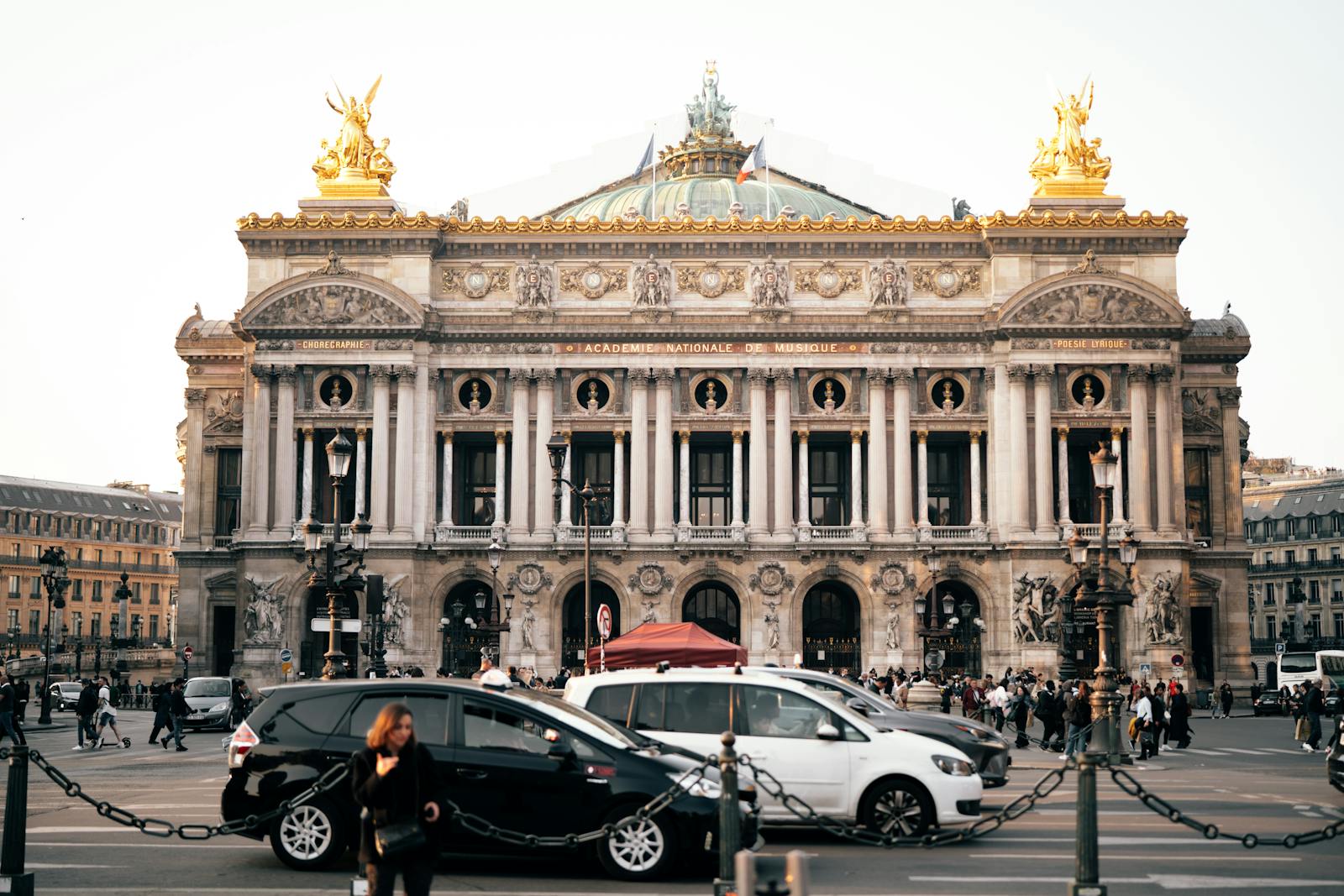
The 1861 design competition drew 171 submissions. The winning entry came from a 35-year-old architect nobody in the Paris hotel had heard of: Charles Garnier, a Prix de Rome winner who had worked on restorations in Greece and Italy but had never designed a major public building. His proposal was audacious — an integrated Beaux-Arts monument where architecture, sculpture, and interior decoration were designed together as a single composition, with the Grand Staircase rather than the auditorium positioned as the building’s primary public space. The idea was that opera-going was as much about being seen as about seeing the performance, and the building’s architecture should accommodate that social reality.
Construction began in 1861 and didn’t finish until 1875 — fourteen years of work interrupted by the Franco-Prussian War of 1870-1871, the siege of Paris, the Paris Commune, and the collapse of the Second Empire. When the building finally opened on January 5, 1875, Napoleon III was dead (exiled after the war, he died in 1873) and France was a republic. The opera house he had commissioned became a symbol of the Third Republic instead — arguably the most successful piece of architectural propaganda of the 19th century.
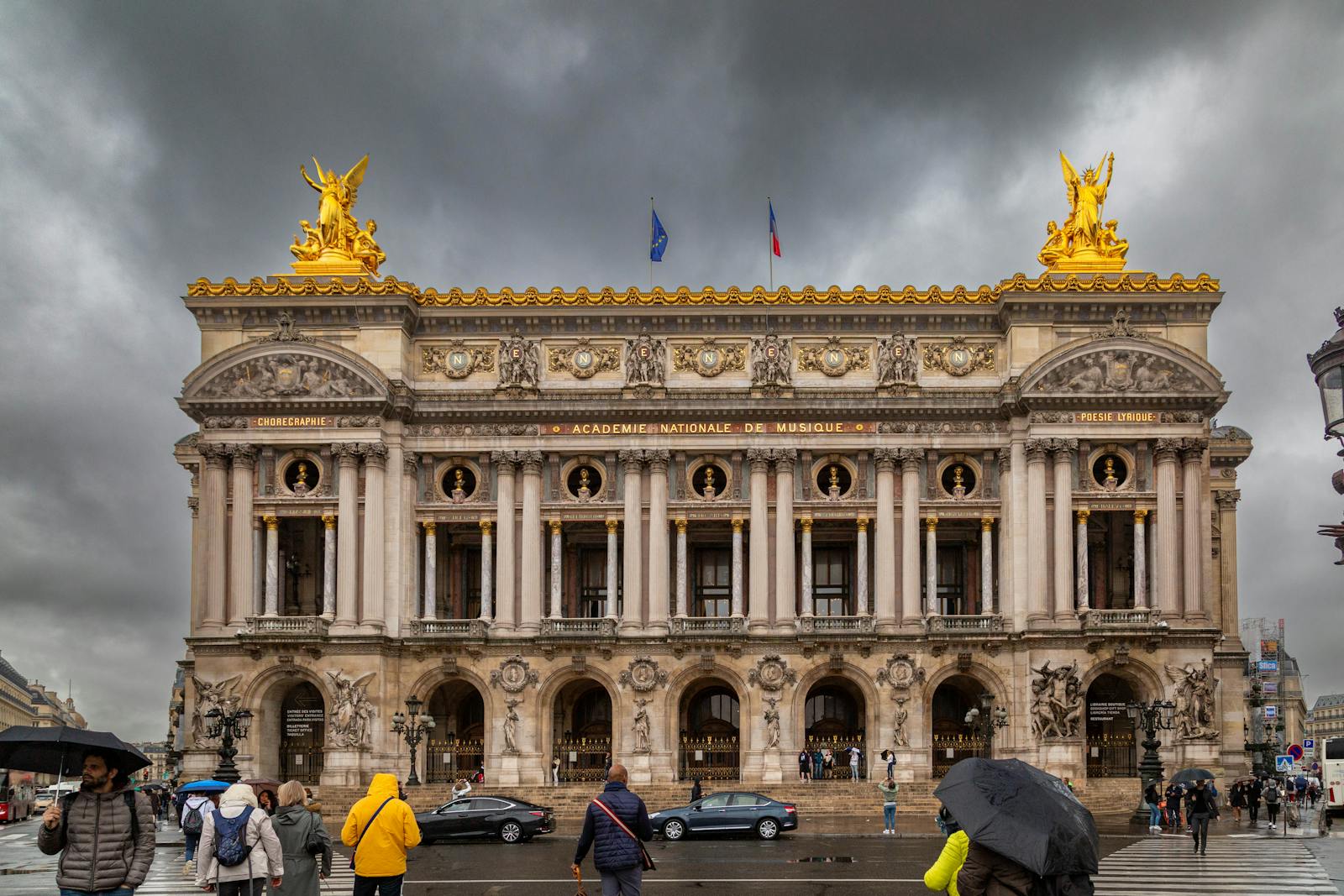
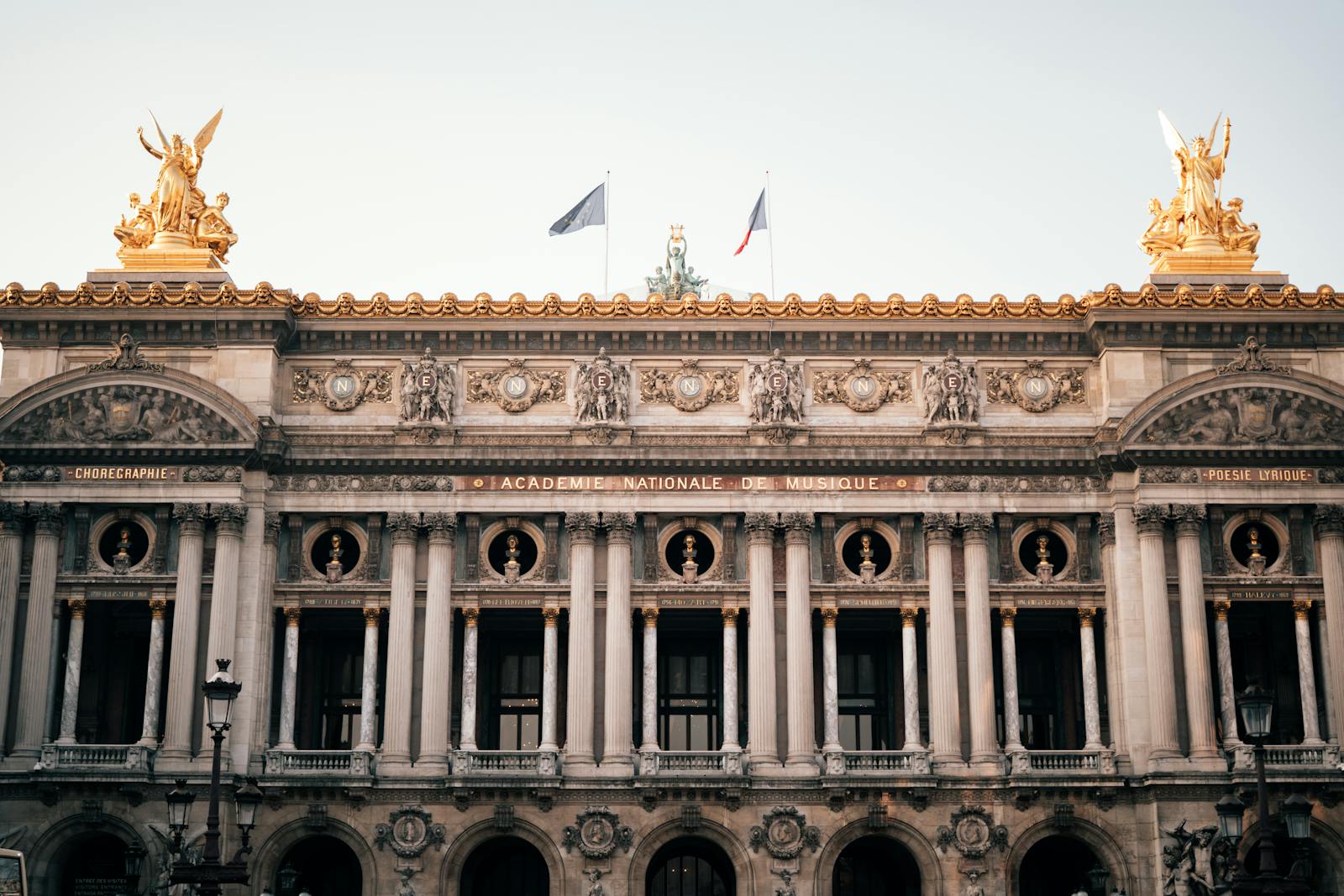
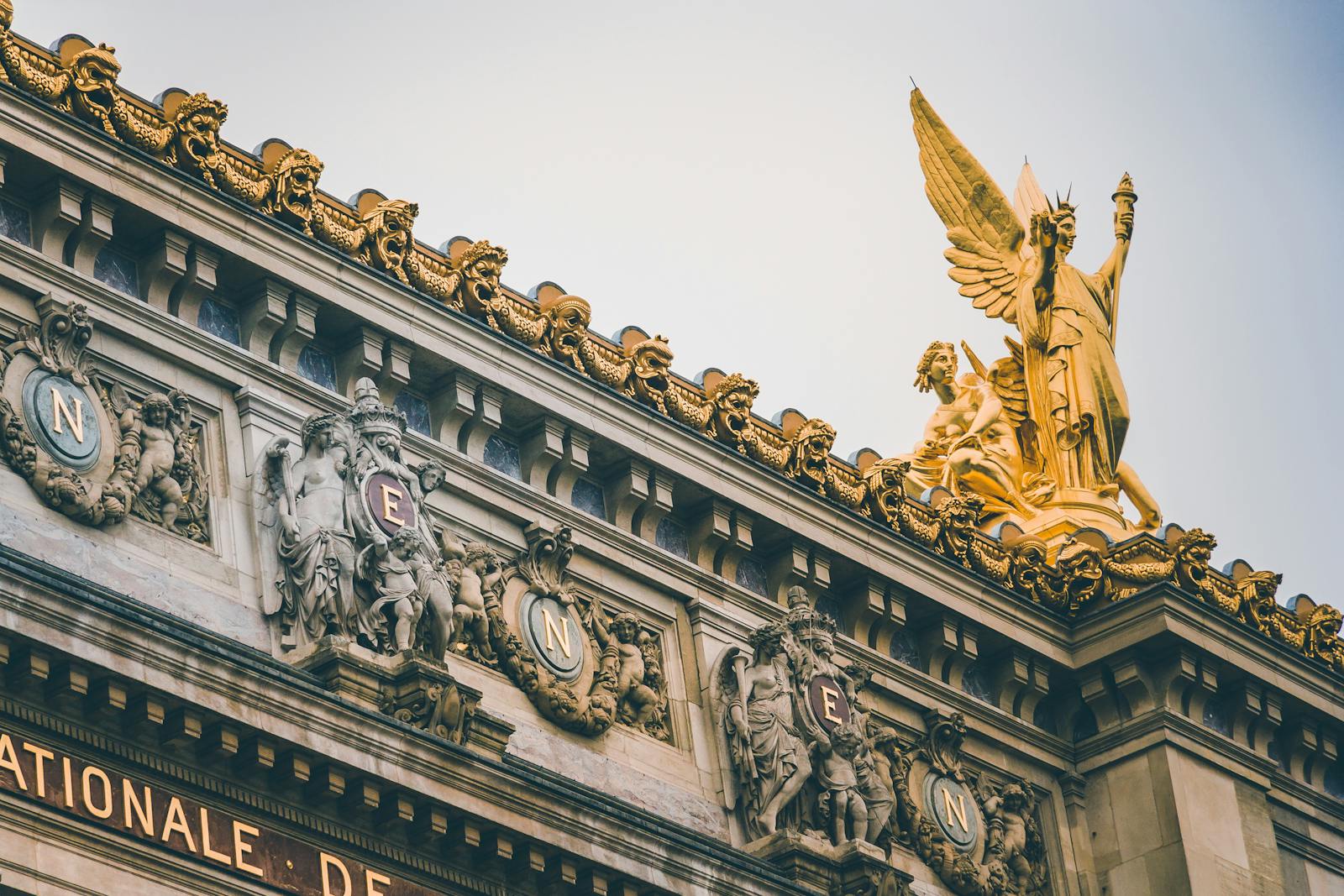
The building’s influence over the next 50 years is hard to overstate. Every major European capital built its own version — the Vienna State Opera (1869), the Semperoper in Dresden (1878), Budapest’s State Opera House (1884), Rio de Janeiro’s Theatro Municipal (1909), Manaus’s Teatro Amazonas (1896). Charles Garnier himself became the most in-demand architect in Europe and went on to design casinos, villas, and the Monte Carlo Opera House in Monaco, using the same Beaux-Arts vocabulary.
The Phantom and the Lake
The most famous story about the Palais Garnier is almost certainly true: there is in fact an artificial lake under the opera house. Construction ran into groundwater problems during the excavation of the foundations in the 1860s, and rather than constantly pump out the water (which would have destabilized the foundations of nearby buildings), Garnier had his engineers build a massive reinforced concrete cistern in the sub-basement that collects and contains the groundwater in a single controlled chamber. It’s still there, still wet, and the Paris fire brigade uses it for underwater diving practice.
Gaston Leroux, a Paris-based journalist and novelist, knew about the lake when he wrote Le Fantôme de l’Opéra in 1909-1910. He made up most of the phantom story, but the physical setting of the novel — the vast underground chambers beneath the opera house, the lake, the hidden passages, the sense of the building containing whole worlds invisible to ordinary visitors — is largely real. The novel was commercially unsuccessful on publication but has been adapted repeatedly, most famously by Andrew Lloyd Webber in 1986, which turned the Palais Garnier into one of the most recognizable opera houses in the world for people who have never visited Paris.
The Chagall Ceiling
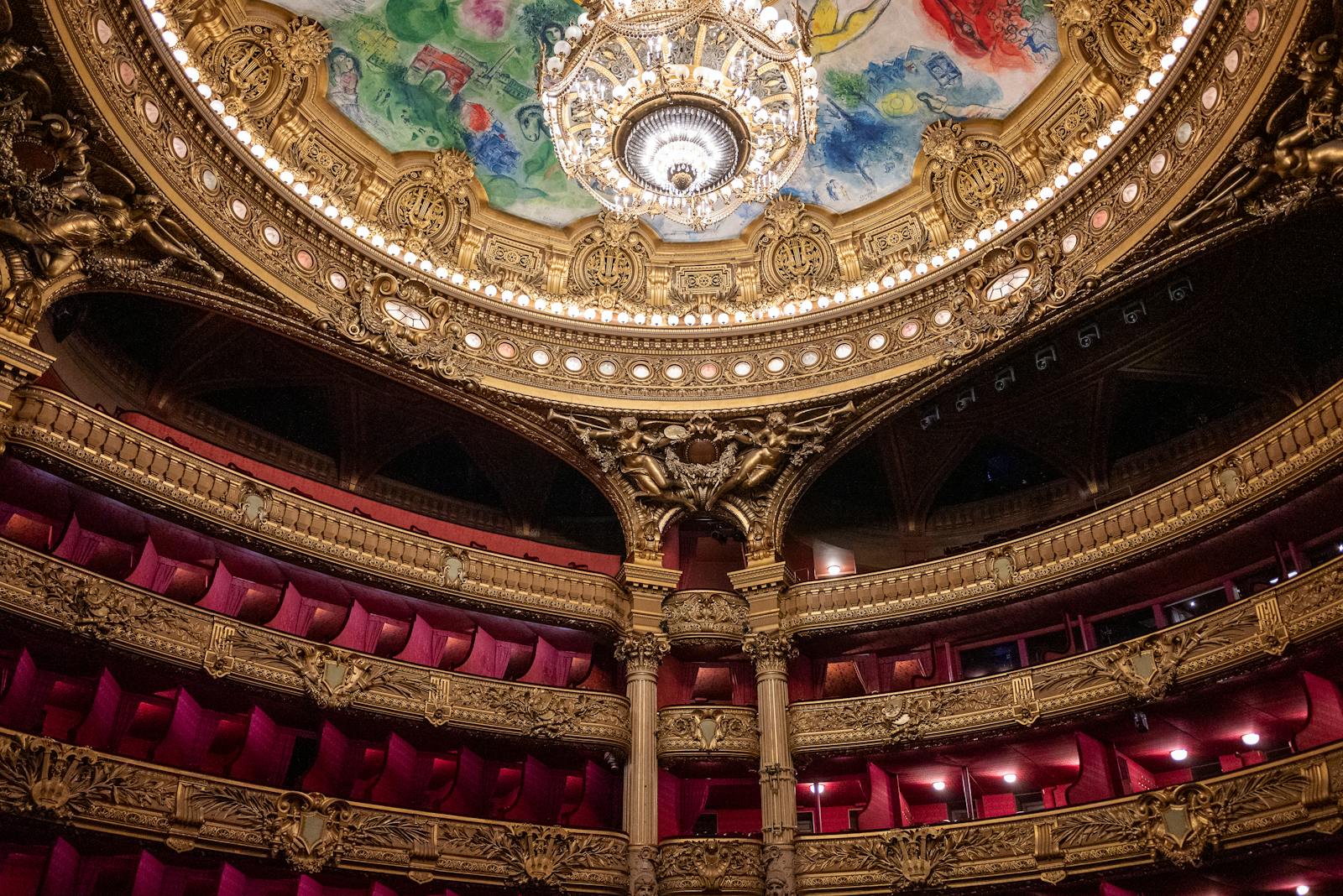
The original auditorium ceiling was painted by Jules-Eugène Lenepveu in the 1870s: a traditional Beaux-Arts composition of muses and allegorical figures in a classical palette. In 1962, the minister of culture André Malraux decided the ceiling needed refreshing and commissioned the 77-year-old Marc Chagall to paint a new one. Chagall’s design, unveiled in 1964, is a 220-square-meter modernist composition in bold blues, greens, yellows, and reds, organized into five sections honoring different composers (Mozart, Wagner, Berlioz, Debussy, and others) with Chagall’s characteristic floating figures and dreamlike imagery.
The decision was enormously controversial at the time and remains debated today. Critics argued (and still argue) that installing a 20th-century modernist work in a 19th-century Beaux-Arts building was an act of cultural vandalism. Supporters argued (and still argue) that the Chagall is itself a masterpiece and that the two works create a productive dialogue across 90 years of French art history. Both positions have merit. The one practical note: the Chagall is painted on a removable panel mounted above the original Lenepveu ceiling, which is still intact underneath. In theory, the Chagall could be removed and the original restored, though nobody has seriously proposed doing so in decades.
What You’ll Actually See
A self-guided visit typically covers five main areas over 60 to 120 minutes.
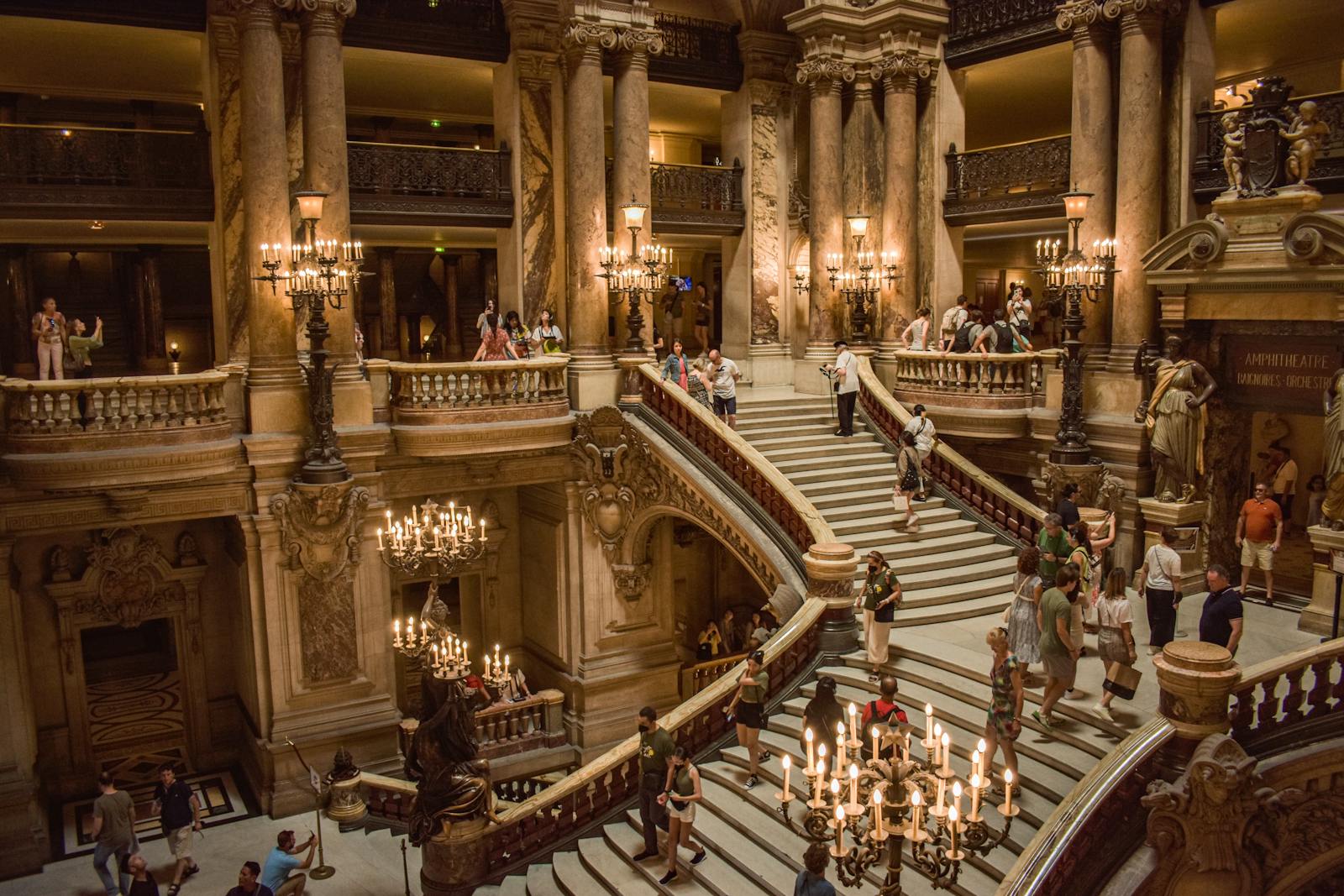
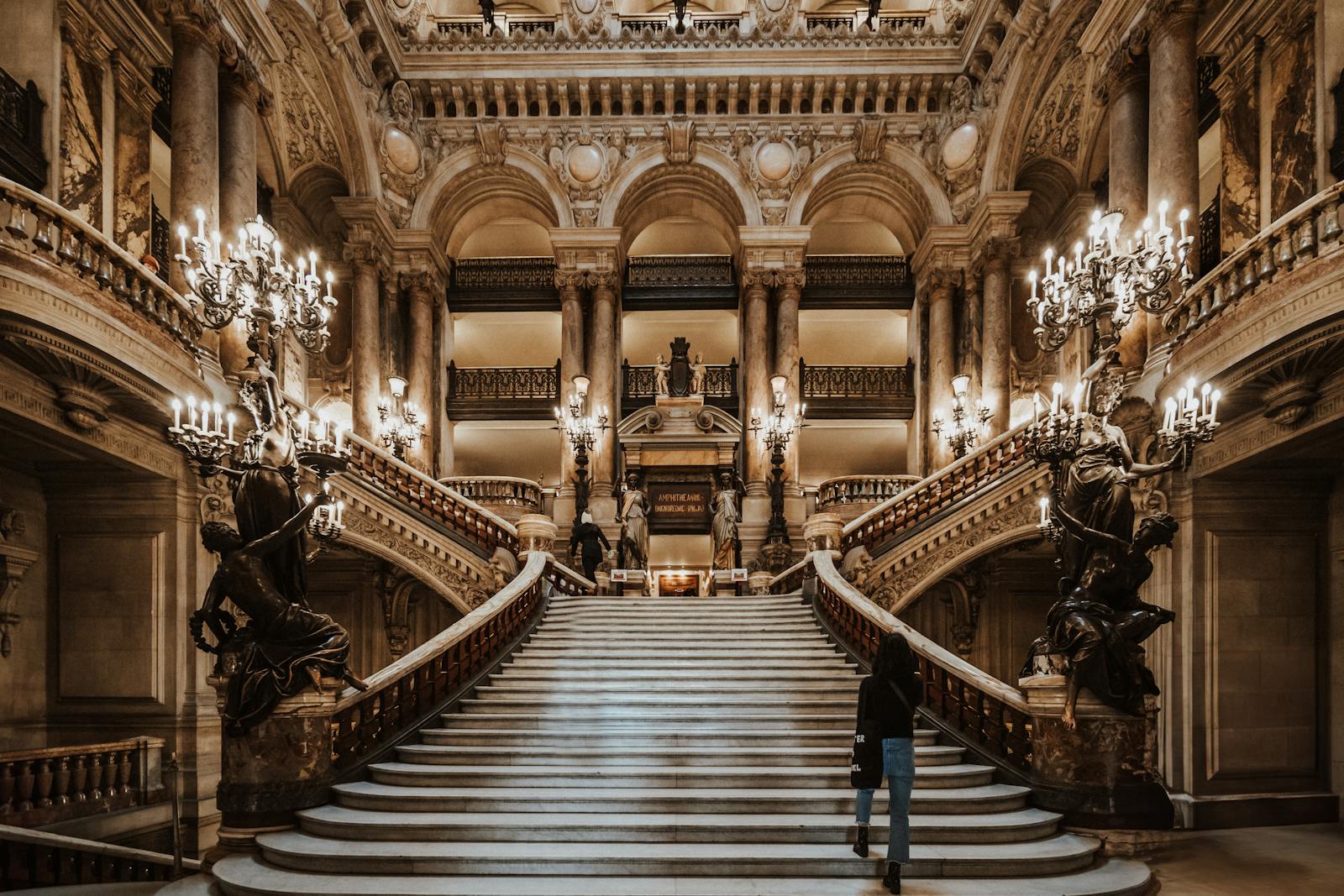
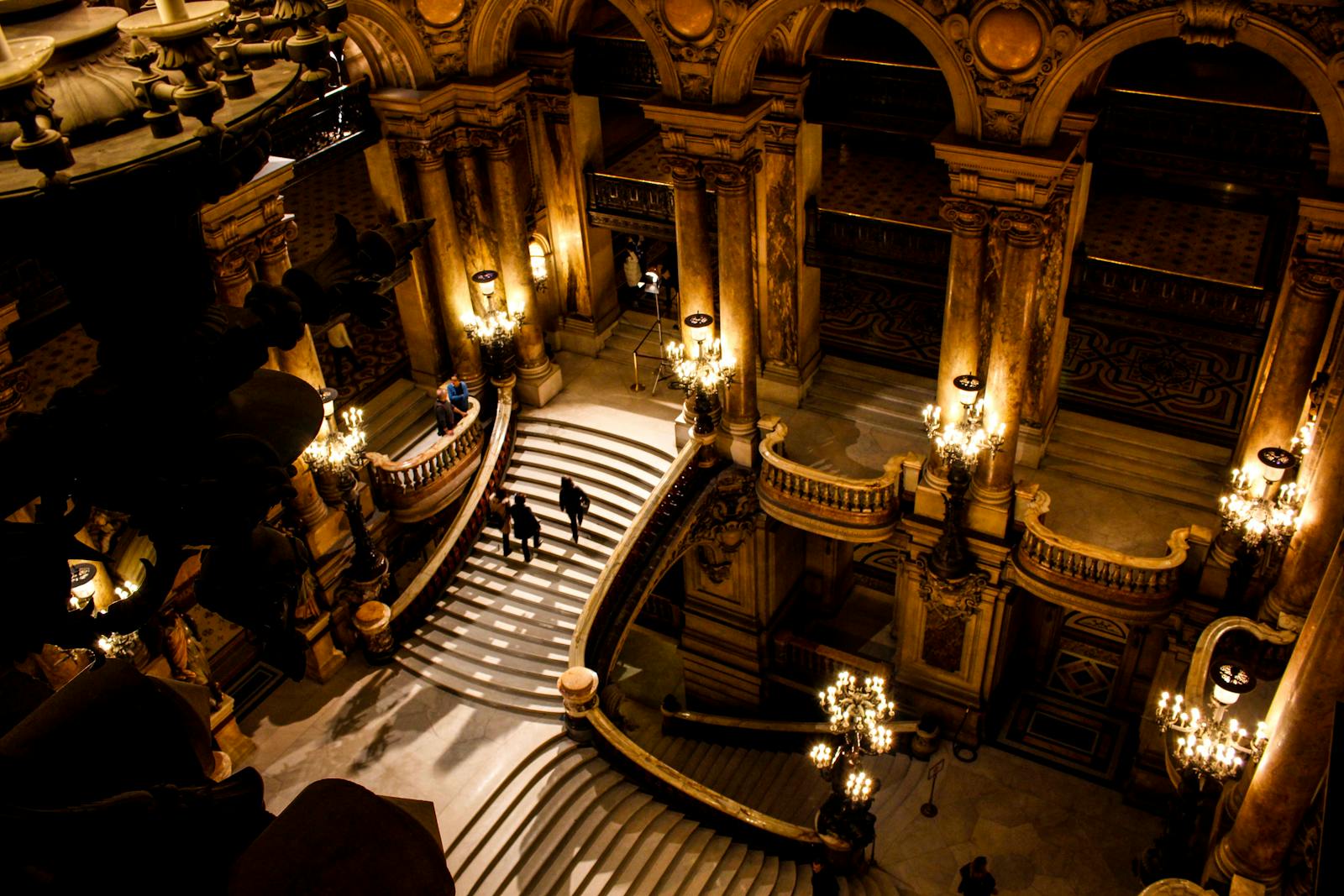
The Grand Staircase (Grand Escalier) is the main entrance hall and the single most famous interior in the building. A double marble staircase that splits as it rises, it was designed as both a functional circulation space and a social stage — 19th-century opera-goers would deliberately arrive early to walk up and down it, see each other, be seen, and establish their place in Paris society before the performance began. The marble is a polychrome mix from quarries across Europe: white Carrara, red Languedoc, green Swedish, black Belgian. The sculptural program by Albert Carrier-Belleuse and others integrates with the architecture rather than sitting on top of it.

The Grand Foyer (Grand Foyer) is the promenade gallery on the first floor — a 60-meter-long mirrored hall modeled on the Hall of Mirrors at Versailles, with painted ceiling panels, chandeliers, and gilt detailing everywhere. This is where intermission socializing happens during actual performances, and during daytime visits it’s the single most Instagram-able space in the building after the staircase. The east and west ends open onto balconies overlooking the Place de l’Opéra.
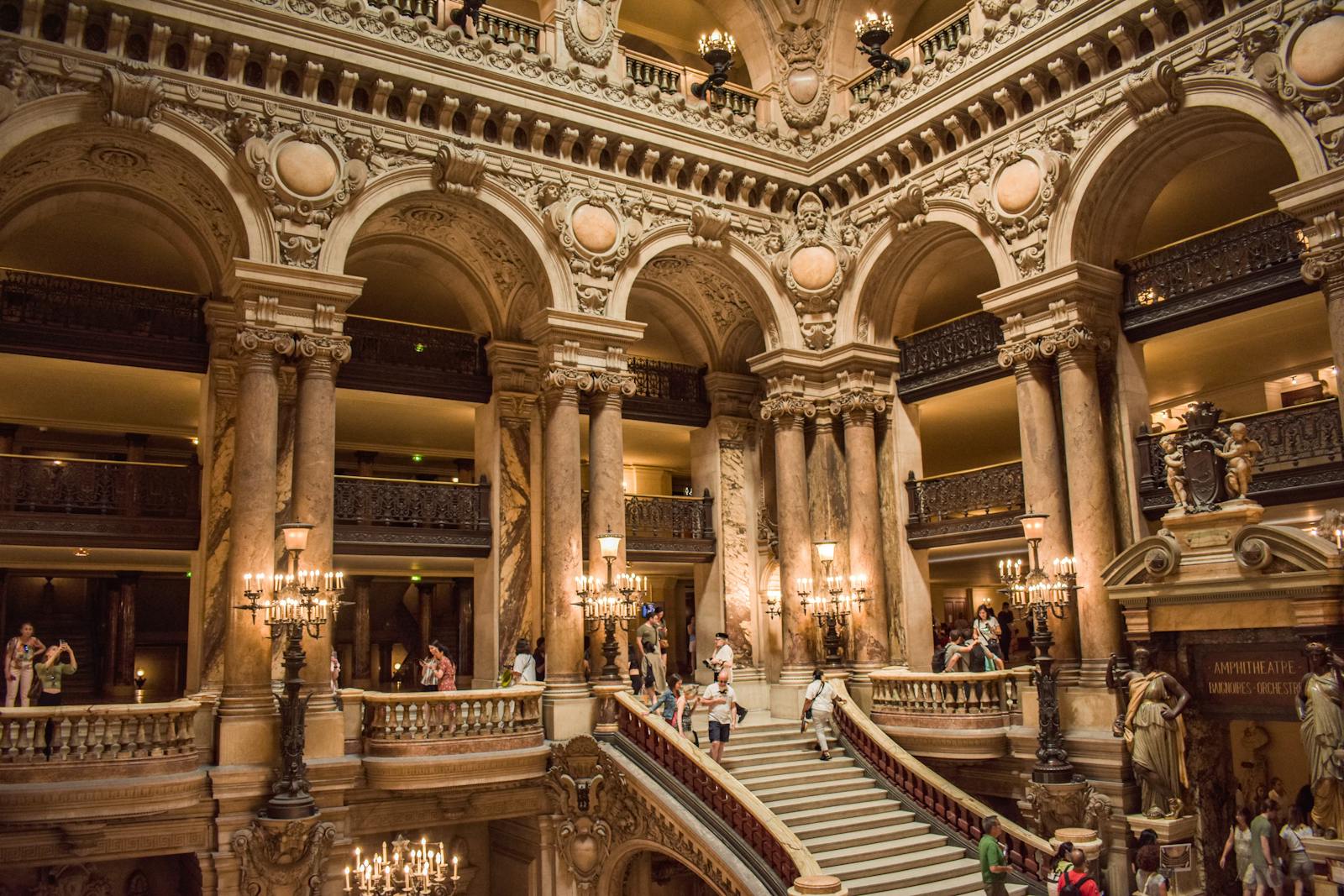
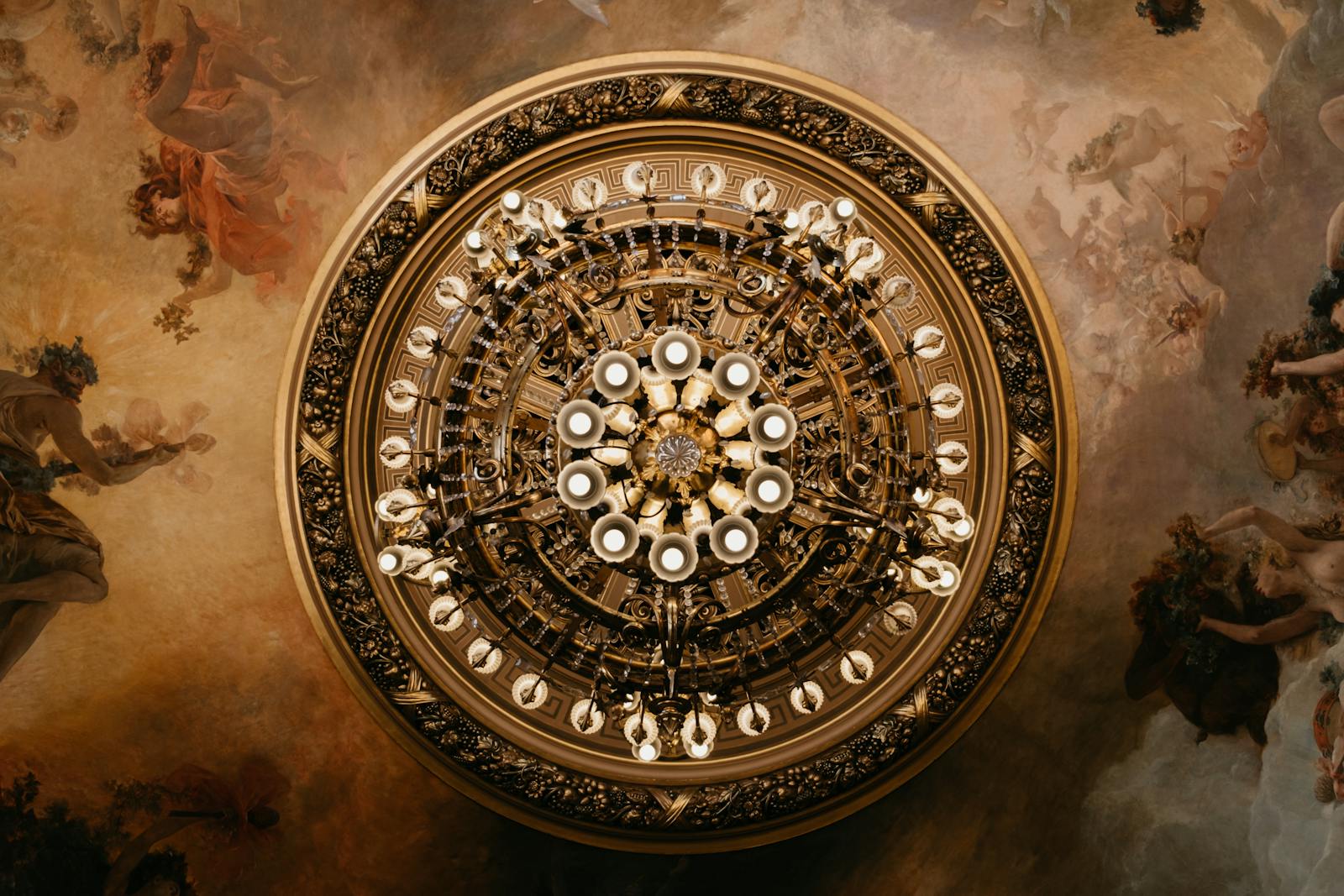
The Auditorium (Salle) is where you see the Chagall ceiling in person and get a sense of the horseshoe-shaped seating arrangement Garnier designed for the Second Empire audience — 1,979 seats arranged in a configuration that prioritized social visibility over sight lines. The auditorium is not always accessible during daytime visits (if there’s a rehearsal or performance setup in progress, you’ll be held outside), but when open, you can sit in the stalls and look up at the Chagall for as long as you want.
The Library-Museum (Bibliothèque-Musée de l’Opéra) contains the Paris Opera’s historical archive, with costumes, set models, scores, photographs, and artifacts from 300+ years of French opera history. It’s included in the entry ticket and is often overlooked by visitors rushing through the main public spaces. Worth 20-30 minutes if you’re already in the building.
The Rotunda Staircase (Rotonde de l’Empereur) is a secondary circular staircase at the east end of the building, less crowded than the main Grand Staircase and featuring some of the most intricate polychrome marble work in the building. Easy to miss if you follow the main flow of visitors; worth the detour.
Practical Tips Before You Book
The best time to visit is weekday mornings, ideally a Tuesday, Wednesday, or Thursday between 10:00 and 11:30. The opera house opens at 10:00 and the first hour is the least crowded, with tour groups typically starting to arrive around 11:30. Avoid Saturdays if you can — weekend crowds in the Grand Staircase area can make it hard to take a clean photo without twenty other phones in frame.
Check the performance schedule before booking. The Palais Garnier is a working opera house, and some areas (particularly the auditorium) are closed during rehearsals and performance setup days. The official Paris Opera website publishes a calendar showing which days have “visite libre” (free visit) versus restricted access. If the auditorium is critical to your visit, pick a day where it’s explicitly open.
Photography is allowed in most public areas including the Grand Staircase, Grand Foyer, and exterior balconies. The auditorium has stricter rules — flash is prohibited, and during some days tripods are not allowed. No drones, obviously.
Wheelchair access is partial. The Palais Garnier is a 19th-century building with grand staircases as its defining architectural feature, which means some key spaces are not accessible to wheelchair users without significant effort. The ground floor is accessible, the auditorium has accessible seating, and there is an elevator that reaches most upper levels, but the Grand Staircase itself can only be experienced on foot.
Budget 60 to 120 minutes for the visit itself. The $18 entry ticket doesn’t specify a departure time, so you can stay as long as the building is open, but most visitors find they’ve seen everything they want to see in about 90 minutes. If you’re doing the Mystery Game (Tour #3), plan on 120 to 150 minutes. If you’re doing the private guided tour (Tour #4), exactly 120 minutes.
Download the operator app before you arrive. If you’re using the audio guide via the partner app, download the app and the specific tour content over hotel WiFi before heading to the venue. Mobile data inside the building can be slow, and the in-venue WiFi isn’t reliable enough to download large audio files.
Bring headphones. See above — the audio guide experience is dramatically better with headphones than holding your phone to your ear, and the marble-and-mirror interior echoes enough that speaker playback bothers other visitors.
Alternatives If These Aren’t Right
Watch an actual performance. If you’re flexible on dates and can book a ballet or opera ticket for a real performance at the Palais Garnier, that’s the most authentic way to experience the building. Tickets start around €15 for the highest balcony seats (with restricted sight lines) and climb to several hundred euros for orchestra seats. The Paris Opera’s official website handles bookings. You’ll still see the Grand Staircase and Grand Foyer during intermission, and you’ll see the auditorium in its intended function.
Visit the Opera Bastille instead. Paris’s other opera house, opened in 1989, is the modern venue where most contemporary productions take place. It’s architecturally unremarkable compared to the Garnier but has better sight lines and a larger stage. If you’re deciding which opera house to actually see a performance at, the answer for most visitors is “the Garnier if you care about the building, the Bastille if you care about the production.”
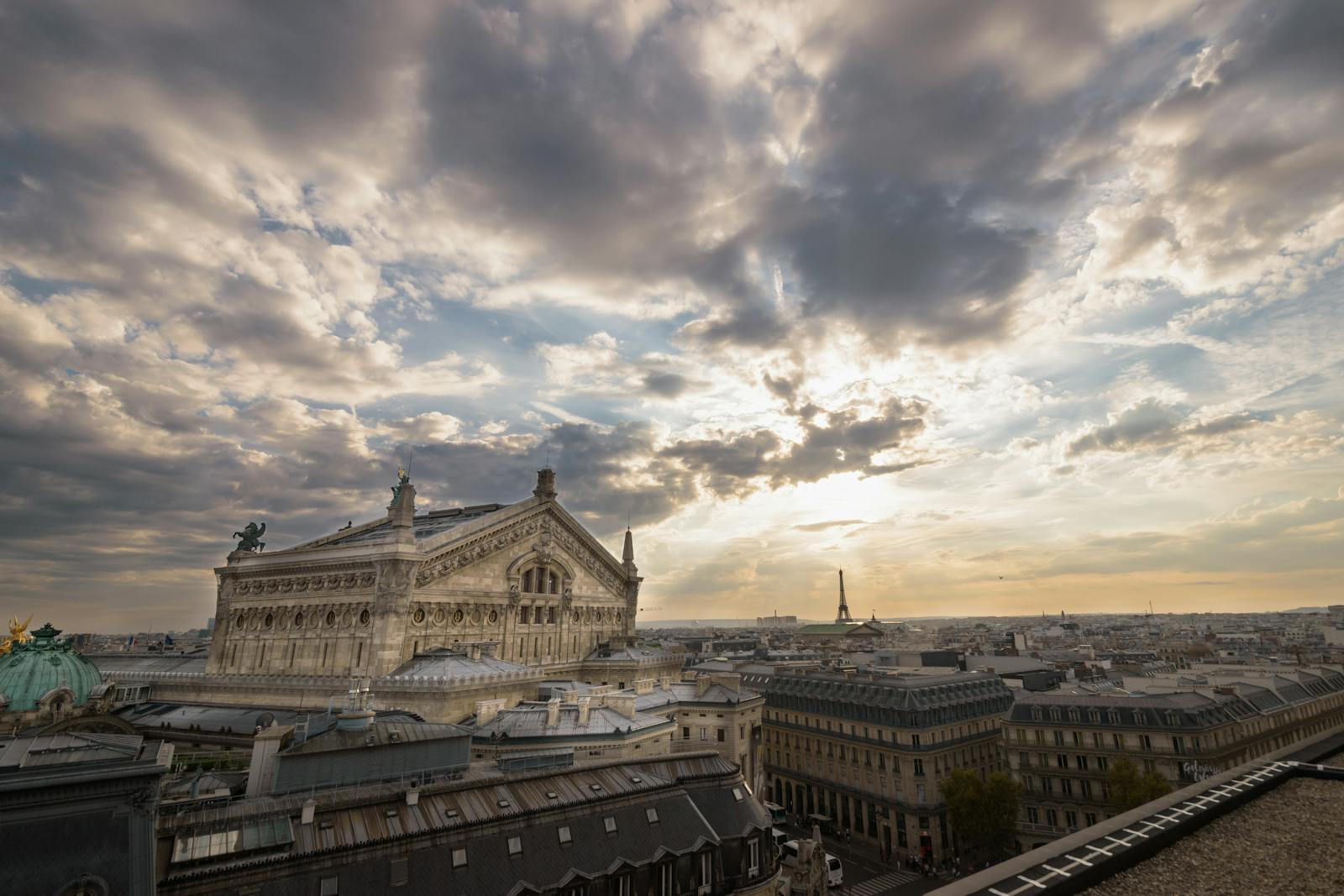
Pair with the nearby Galeries Lafayette. The Palais Garnier is across the street from Galeries Lafayette Haussmann, the flagship Paris department store with a 19th-century glass dome that rivals the opera house for architectural drama. Free to enter, open late, and the rooftop terrace has one of the best free views of central Paris. A Palais Garnier visit in the morning plus Galeries Lafayette in the afternoon makes for a well-structured half-day in the 9th arrondissement.
More Paris and France Guides
The Palais Garnier pairs naturally with several other Paris interior visits. The Louvre Museum tickets guide covers the timed-entry system for Paris’s other major interior monument, and the Orsay Museum tickets guide handles the former train station that now houses the best Impressionist collection in the world. Both are walkable from the Palais Garnier (the Louvre is 12 minutes, the Orsay is 18 minutes).
For the classical Paris exterior monuments, see the Eiffel Tower tickets guide (with the four actual ways to get up), the Arc de Triomphe rooftop guide for the best free-standing view in central Paris, and the Seine sightseeing cruises guide for the river-level view. If you’d rather eat than sightsee, the Paris food tours guide covers the four best walking food experiences in the city, and the Versailles day trip guide handles the classic Louis XIV palace day out. For day trips further afield, the Normandy D-Day beaches guide and the French Riviera day tours from Nice guide both cover major multi-hour excursions.
Which Tour Should You Actually Book?
If you want the simplest and cheapest answer, Tour #1 (Opera Garnier Entry Ticket) is the right choice for probably 70% of visitors. $18 per person, 16,070 reviews averaging 4.6 stars, reserved access, self-paced. Buy it, download the app, show up with headphones, spend 90 minutes, leave happy. It’s the default option and the default is the right answer most of the time.
If you’re already planning to do a Seine cruise anyway, Tour #2 (Palais Garnier + Seine Cruise Combo) bundles them at a modest savings and simplifies booking logistics. $42 per person, one voucher for both. The operational caveat about coordinating two separate venue locations matters, but the math works for most travelers.
If you want an interactive experience that’s neither a boring audio guide nor an expensive private tour, Tour #3 (Palais Garnier Mystery Game) is a genuinely different format that works well for couples and families. $32 per person, 2-2.5 hours of puzzle-solving in one of the most beautiful interiors in Paris. Read the listing before booking so you know what you’re getting.
If the Palais Garnier is a genuine priority for you and you want the full historical context, Tour #4 (Private 2-Hour Guided Tour) is the premium option. $203.52 per person is a lot relative to the other three choices, but the guide quality is consistently excellent and you leave the building understanding what you just saw.
Final Word
The Palais Garnier is one of the two or three best indoor experiences in central Paris, and at $18 for the entry ticket it’s arguably the best value per square meter of beautiful interior on any Paris sightseeing list. Charles Garnier designed it to impress 19th-century emperors and aristocrats, and 150 years later it still does exactly that job on anyone who walks through the front door. The only decision is which of the four formats above matches your budget and your preference for guided versus self-paced exploration.
Book at least two or three days ahead during peak season (May through September and Christmas week) because the popular morning time slots on the basic entry ticket do sell out, and walk-up access during busy weeks can mean waiting in a 45-minute line you could have avoided. Off-season, same-day bookings are usually fine. Either way, go with headphones and morning energy — this is a building that rewards looking up, looking down, and looking at specific details, not a speed-run monument.