
The first 30 seconds on a Segway are terrifying. You lean forward and the machine lurches. You lean back and it stops dead. Your body doesn’t trust the gyroscope. Then something clicks — literally, in your brain — and suddenly you’re gliding along the Seine at 12 kilometres an hour with the Eiffel Tower ahead of you, the Louvre behind you, and a stupid grin on your face that you can’t remove for the next two hours. Every single person on a Paris Segway tour ends up grinning. It’s a law of physics.
Segway tours in Paris cover more ground than walking tours without the sweat of cycling, and they go places that buses can’t reach — through parks, along pedestrian quays, between the columns of the Grand Palais. The tours are small-group (usually 8-10 people), guided by locals who know every shortcut, and the Segways themselves are surprisingly easy to ride once you stop overthinking it. The perfect 5.0 ratings across all three major operators aren’t a coincidence — this is genuinely one of the most fun things you can do in Paris.


Best quick option: Segway Express Tour — $53, 1.5 hours, 12 monuments. Also 5.0.
Best extended: Half-Day Guided Segway Tour — $60, 3 hours, deeper exploration. Also 5.0.
- How Segway Tours Work in Paris
- The Three Tour Options
- Who Should (and Shouldn’t) Book
- What the Guides Actually Tell You
- Segway vs. Bike vs. Walking: Which Tour Format?
- Safety and Practicalities
- Segways and Paris Weather
- Best Segway Tours to Book
- 1. Amazing Paris Segway Tour —
- 2. Paris Segway Express Tour —
- 3. Half-Day Guided Segway Tour —
- More Ways to See Paris
How Segway Tours Work in Paris
You show up at the meeting point (usually near the Eiffel Tower or Trocadéro), get fitted with a helmet, and spend about 15 minutes on a training session. The guides are patient — they’ve taught thousands of first-timers and they won’t let you onto the street until you can start, stop, turn, and navigate obstacles confidently. Nobody gets left behind, and nobody falls off (well, almost nobody).

The group then follows the guide through a predetermined route, stopping at landmarks for photos and commentary. The guides use radio earpieces so you can hear the narration while riding — no need to gather in a circle at every stop. The pace is leisurely but you cover serious ground: a 2.5-hour tour typically passes 15-20 landmarks that would take 5-6 hours on foot.

The Three Tour Options
The Express Tour (1.5 hours, $53) is the best choice if you’re short on time or just want to test the Segway experience. It covers 12 monuments in a quick loop — Eiffel Tower, Invalides, Place de la Concorde, Tuileries, Louvre pyramid, Pont Alexandre III, and back. No deep dives, just a greatest-hits circuit that gives you a taste of everything.

The Amazing Tour (2.5 hours, $77) is the sweet spot — long enough to cover the major landmarks with time for proper stops and commentary, short enough not to exhaust you. The route typically adds the Grand Palais, the Petit Palais, the Palais de Chaillot, and the Musée d’Orsay to the express route, and the extra time means longer photo stops and more historical context from the guide.

The Half-Day Tour (3 hours, $60) is the most thorough. It extends into the Marais, the Latin Quarter, and sometimes Montmartre, depending on the guide and the group’s interest. At $60 for 3 hours, it’s actually the best value per hour on this list — cheaper than the express and longer than the Amazing tour.

Who Should (and Shouldn’t) Book
Perfect for: First-time Paris visitors who want to orient themselves quickly. Anyone who finds walking tours too slow and bus tours too removed. Groups of friends who want a shared experience. People who’ve always wanted to try a Segway but never had a reason.
What the Guides Actually Tell You
The history delivery on a Segway tour is different from a walking tour. You’re moving, so the guides use the radio to deliver shorter, punchier stories — anecdotes rather than lectures. A walking tour might spend 15 minutes at the Invalides explaining Napoleon’s tomb. A Segway guide gives you the 90-second version while you glide past, then adds a detail at the next stop that connects back. The style works because the Segway keeps your energy up — you’re never standing in one spot long enough to get bored or cold.

The best guides treat the Segway tour as a conversation rather than a script. They ask where you’re from, what you’ve already seen, and what interests you. Then they adjust — more art history for the culture buffs, more Revolution stories for the history fans, more restaurant recommendations for the foodies. The small group size (8-10 people) makes this personalisation possible in a way that bus tours can’t match.

Segway vs. Bike vs. Walking: Which Tour Format?
Paris offers all three, and each has genuine advantages.
Segway: Most ground covered with least effort. Fun factor is highest. Best for first-time visitors or anyone who wants the overview without physical demand. Downside: you can’t lock a Segway and walk into a museum, so the tour is limited to exterior views and brief stops.
Bike: More exercise, more immersion. Bikes go everywhere, including through the Marais’s narrow streets and along the canal towpaths. The Paris bike tours are excellent and cover routes that Segways can’t easily navigate. Best for active visitors who enjoy cycling and want to feel the city rather than glide past it.
Walking: Deepest experience but least ground covered. Walking tours excel at neighbourhood-specific exploration — the Latin Quarter, Montmartre, the Marais — where the stories require standing still and looking closely. Best for visitors who’ve already done the overview and want to go deeper into specific areas.


Not ideal for: Anyone with serious balance issues or mobility problems that affect standing. Very young children (most tours require riders to be at least 12 and weigh at least 45kg). People who strongly prefer depth over breadth — a Segway tour is a tasting menu, not a full meal. And anyone who hates looking like a tourist — there’s no way to ride a Segway through Paris without broadcasting your visitor status to everyone within 50 metres.

Safety and Practicalities
Paris Segway tours have an excellent safety record. The machines are electronically limited to about 12 km/h, the guides carry first aid kits, and the routes are chosen to avoid heavy traffic. Helmets are mandatory and provided. Insurance is included in the tour price. The most common injury is a bruised ego from wobbling during the training session.

What to wear: Closed-toe shoes are mandatory. Trainers or flat shoes work best. Avoid long skirts, loose scarves, or anything that might catch in the wheels. Dress for the weather — you’re outdoors for 1.5-3 hours with no shelter. Sunscreen in summer. Gloves in winter.
Booking: Book at least 2-3 days ahead for weekend tours, which fill up fast. Weekday morning tours are easier to get. All three operators allow online booking through Viator with free cancellation up to 24 hours ahead.



Segways and Paris Weather
Paris weather is unpredictable. The tours run in most conditions, but your experience varies significantly. Sunny days are obviously ideal — the monuments look their best, the parks are green, and you won’t need extra layers. Overcast days are fine — the even light actually produces better photos than harsh sunshine, and the tours feel less hot in summer.
Light rain makes the cobblestones reflective and adds atmosphere, but you’ll want a waterproof jacket. Heavy rain or thunderstorms cancel tours (full refund). Winter tours run but it’s cold — gloves, scarf, and warm layers are essential when you’re standing on a platform at 12 km/h for 2+ hours. Spring (April-June) and early autumn (September-October) are the ideal seasons: mild weather, long daylight, and manageable tourist crowds.
Meeting points: Most tours meet near the Eiffel Tower (around Trocadéro or Champ de Mars). The exact location is sent after booking. Arrive 15 minutes early for the training session. Late arrivals miss the training and can’t join the tour — the guides are strict about this because safety requires everyone to complete the full training.

Best Segway Tours to Book
1. Amazing Paris Segway Tour — $77
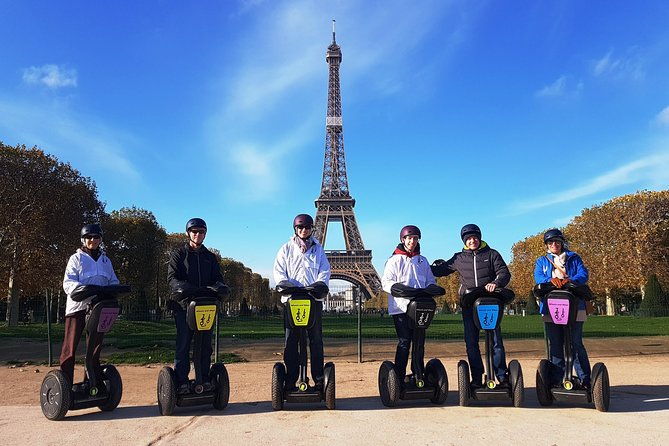
The flagship experience. 2.5 hours covering 15+ landmarks with a local guide, radio commentary, and photo stops at every major monument. The route is refined from thousands of tours into the optimal sequence — each landmark leads naturally into the next, and the guide weaves history and anecdotes into a seamless narrative. Our review covers the full route, the training process, and what makes this operator’s guides consistently excellent.
2. Paris Segway Express Tour — $53
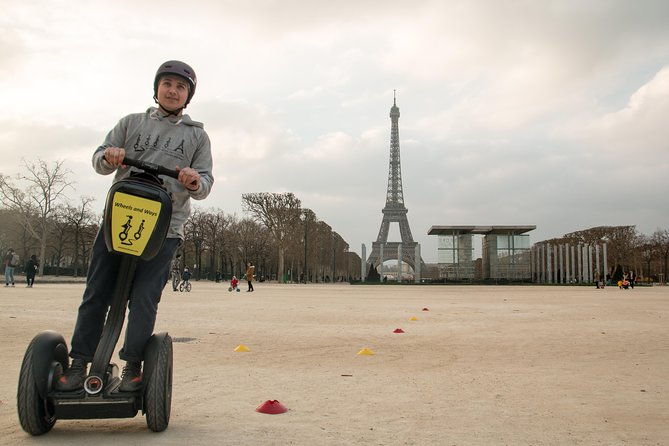
The short version for time-pressed visitors. 12 monuments in a tight loop that covers all the central Paris essentials. The pace is faster — less time at each stop, but more riding between them. If you want the Segway experience without committing half a day, this is the one. Our review compares the express to the full tour and explains what you gain and lose with the shorter format.
3. Half-Day Guided Segway Tour — $60

The most thorough option. Three hours with a local guide, covering the central landmarks plus deeper exploration of one or two neighbourhoods. The longer format means more stories, more hidden corners, and a more personalised experience — the guide adjusts the route based on the group’s interests. Our review covers the extended route options and why the 3-hour format is worth the extra time investment.
More Ways to See Paris
If Segways aren’t your style, Paris has plenty of other ways to see the city from an interesting angle. The bike tours cover similar ground with more exercise and a lower tech profile. The night walking and ghost tours show you a different Paris entirely — dark, historical, and on foot. The Montparnasse Tower gives you the aerial view that the Segway gives you at street level. And for something completely different, the cooking classes let you explore Paris through its food rather than its geography. Between Segways, bikes, boats, buses, and walking tours, the city offers enough perspective shifts to keep you busy for a week.